
 English
 русский
 Español
 عربى

Product Consultation
Your email address will not be published. Required fields are marked *
Coming From China, Marketing To The World.
A label converter sent over a specification sheet in late July: rolls for a 2027 programme, minimum 40% bio-based carbon, VOC under 50 g/L, and a food-contact review by a European brand owner. Three conditions, all filed under "sustainability", all verified by different tests and all pointing at different cost structures. Treat them as one requirement and the team either overpays or signs off on a roll that never passes aging.
The short version: treat bio-based content as a purchasing metric, not a sustainability statement. Specify it as a percentage measured by ASTM D6866 or EN 16640, separate it from the heat and shear tolerances you actually need, and keep VOC on its own line. Split this way, a bio-based adhesive becomes a formulation decision rather than a compliance gamble.
Core takeaways
Content
Three properties get bundled into one word in most tender documents, and they are not interchangeable. Getting the definitions right at the start saves a full round of re-testing later.
Bio-based content
The share of carbon that came from recently living material rather than petroleum. Measured by radiocarbon analysis under ASTM D6866, EN 16640 or ISO 16620-2, and normally reported either as a share of total carbon or as a share of total mass.
Biodegradability
A rate measured under defined conditions: soil, marine, industrial compost. A high bio-based share does not imply any of these results. A starch-rich hot melt can still sit unchanged in landfill for years.
Compostability
A pass/fail outcome against a certification scheme, typically EN 13432 or ASTM D6400. It covers disintegration, ecotoxicity and heavy metals, and it applies to the finished article, not to the adhesive alone.
There is a fourth property that rarely gets written into the spec but shows up during qualification: compatibility with existing recycling streams. An adhesive that releases cleanly in a paper mill's repulping line is worth more to a packaging converter than one with a 20-point higher biomass figure that smears the screen. When a supplier quotes a biomass percentage, ask separately how the coated product behaves in the customer's end-of-life route.
Six families dominate commercial formulations, and each one trades something away:
Practical implication: the cheapest way to raise bio-carbon in an existing product is to swap the tackifier, not the polymer backbone. Tackifier swaps typically cost less than a full binder change and rarely force a new coating line setting.
The comparison below reflects typical figures seen across commercial grades rather than a single supplier's catalogue. Range width matters more than any individual number.
Table note: ranges are indicative of grades commonly available on the market and will shift with formulation, coating weight and the analytical basis used for reporting.
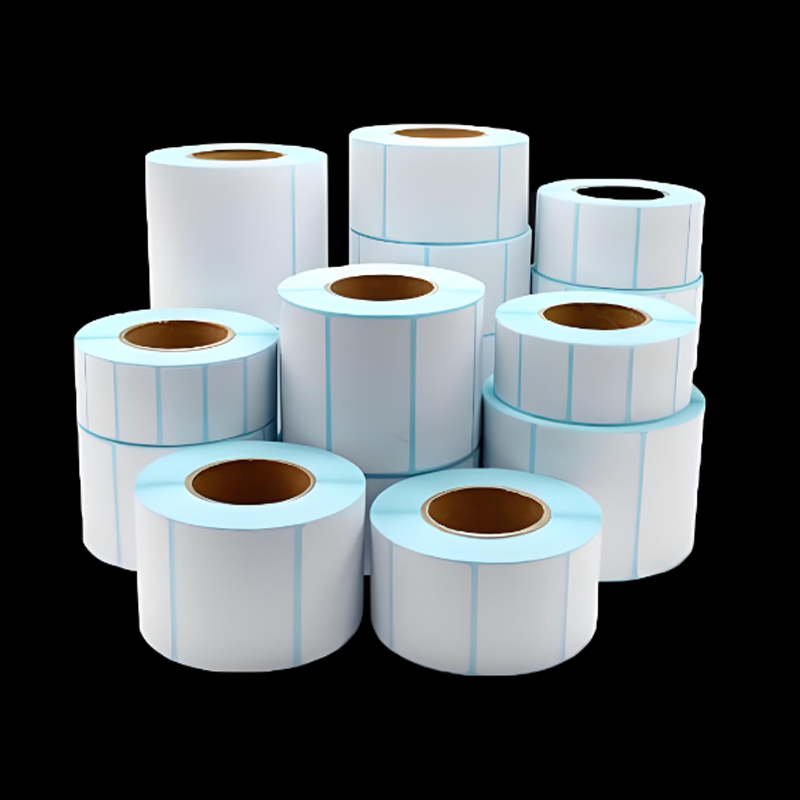 Water-Based Adhesive Grid Base Thermal Paper S-HRM-3FThermal paper label material with water-based adhesive, grid base, and customizable glue thickness and 180° steel plate peeling force.View Product →
Water-based chemistry is where label and thermal paper work usually starts, because the coating window is already established and the change is made inside an existing drying profile. Replacing part of the acrylic binder with a bio-based dispersion shifts rewetting speed and blocking resistance, so the oven curve is normally re-profiled before anything else is touched. The water-based adhesive thermal paper range on this site is a fair example of where those adjustments land in practice.
 YH-TFTR 50# Dual-Silicone Hot Melt Adhesive FilmDual-silicone hot melt adhesive film with no substrate and customizable glue thickness, presented as a benchmark for hot-melt reformulation.View Product →
Hot melt is the lower-risk entry point. There is no solvent to recover and no water to evaporate, so raising bio-carbon through rosin ester or plant-wax substitution mostly changes open time and softening point rather than the entire process. Dual-silicone hot melt film is a useful benchmark here: the carrier construction stays the same and the adhesive layer absorbs the change.
Solvent rubber remains the hardest platform to move. Bio-carbon ceilings are low, capture and recovery costs are already sunk, and reformulation triggers new VOC permitting in most jurisdictions.
Buyers tend to fixate on the bio-carbon percentage and overlook the second number that decides whether the project survives: performance retention after aging. The chart below shows typical bio-carbon levels by chemistry; the trade-off is that the highest bars are not automatically the ones that hold shear strength at 70 °C for 500 hours.
Chart note: indicative bio-carbon levels by chemistry family, based on published technical data and typical formulation practice, not on a single test batch.
Two things usually go wrong when this is ignored. First, peel strength measured at 23 °C looks fine on the incoming inspection sheet and then collapses in a summer warehouse. Second, yellowing appears on white facestock after eight to twelve weeks, which matters enormously for a premium label and hardly at all for an internal logistics tag. Write the aging condition into the specification before the first trial roll is coated.
Demand for bio-based adhesives is not evenly spread, and knowing where the volume concentrates tells you which suppliers will have mature grades and which are still sampling.
Share of consumption by end-use segment, expressed as an approximate market split rather than a fixed forecast.
Packaging dominates because the regulatory pressure lands there first, and because paper and board substrates tolerate starch and protein chemistry better than smooth plastic films do. Electronics and batteries remain a small slice, but they are the segment where a bio-based claim is least likely to justify a performance compromise — which is exactly why qualification cycles there run long.
Trying to convert an entire product family in one quarter is the most common reason these projects stall. A staged route works better:
Step 1 – fix the metric
Decide whether the target is bio-carbon percentage, VOC, compostability or recyclability. Each has its own test method and its own acceptable range.
Step 2 – baseline the incumbent
Record tack, peel, shear and aging data on the current product. Without a baseline, every later result is arguable.
Step 3 – start with hot melt
Tackifier substitution is the least disruptive change and gives the fastest read on whether the customer will accept a shifted performance envelope.
Step 4 – age it properly
Run trials at the storage temperature your customer actually has, not the one in the standard. Twelve weeks minimum for anything facing a warm warehouse.
Step 5 – secure the paperwork
Confirm the supplier can issue a 14C test report tied to the delivered batch, not a generic certificate for the chemistry family.
Step 6 – scale one line at a time
Convert the highest-margin, lowest-volume SKU first so a failed trial costs a batch rather than a quarter.
Coating capability determines how quickly this can move. A line that already runs multiple adhesive families with independent oven zones and clean changeover procedures can absorb a bio-based grade in a couple of trials; a single-purpose line cannot. Reviewing the coating workshop setup before committing to a timeline is more useful than debating the chemistry in isolation.
Once a bio-based grade is approved, day-to-day handling changes in ways that rarely appear on the data sheet.
 140G Yellow Base Removable Double-Sided Adhesive TapeRemovable double-sided PET tape with yellow base, customizable glue thickness, and differential 180° steel plate peeling force for rework.View Product →
Removable systems deserve a separate mention because they are often the first place a reformulation is felt. A removable double-sided tape that releases cleanly from the substrate gives assembly teams a recovery path when a bio-based grade behaves differently on first contact — and rework tolerance is frequently worth more on a production line than a few points of biomass.
Finally, align the technical target with the wider programme. Companies that publish a sustainability commitment usually have an internal definition of what counts as bio-based, and it may be stricter than the customer's. Matching the two definitions before the first trial avoids the awkward situation where a technically compliant product fails an internal audit.
Bio-based adhesives are a straightforward engineering problem wearing a complicated sustainability label. Pick the metric, baseline the incumbent, start where the process change is smallest, and hold the supplier to a test report rather than a brochure. The biomass percentage will follow; the bond has to work first.
Your email address will not be published. Required fields are marked *
 Self Adhesive Label Material Manufacturers