
 English
 русский
 Español
 عربى
عربى
Product Consultation
Your email address will not be published. Required fields are marked *

Coming From China, Marketing To The World.
Content
Choosing the right label material is one of the most important decisions in product packaging, inventory management, and brand presentation. The wrong material can result in labels that peel prematurely, fade under UV exposure, smear during printing, or fail to adhere to challenging surfaces. Whether you are sourcing commercial label materials for large-scale product lines or selecting durable label materials for industrial equipment, understanding the core properties of each material type saves time, reduces waste, and protects your brand's credibility.
We offer a wide range of high-quality self-adhesive label materials for a variety of applications, including industrial, commercial and personal use. Our label materials are engineered for adhesion, durability, and printing performance to meet the diverse needs of our customers — from small businesses applying labels by hand to large manufacturers running automated labeling lines.
Before comparing specific material types, it helps to understand the three fundamental performance pillars that determine whether a label will succeed in a given application.
Adhesion refers to how effectively a label bonds to a surface. This is influenced by the adhesive type (permanent vs. removable), the surface texture (smooth glass vs. corrugated cardboard), and environmental factors such as temperature and humidity. For cold-chain logistics or outdoor equipment tags, a high-tack permanent adhesive is essential. For retail pricing or reusable containers, a removable or repositionable adhesive is more appropriate.
Durability encompasses resistance to physical abrasion, moisture, chemicals, UV light, and temperature extremes. A label used on a warehouse shelf in a climate-controlled environment has vastly different durability requirements than one applied to an outdoor pipeline or a bottle submerged in an ice bucket. Matching material durability to the actual use environment prevents premature label failure and costly reprinting.
Not all materials accept ink or toner equally well. Paper stock absorbs ink differently than polyester or polypropylene film. Thermal transfer printing requires a compatible face stock to produce sharp, long-lasting barcodes and text. When printing performance is poor, readability suffers — which creates real problems in retail scanning, compliance labeling, and traceability workflows.
Durable label materials are specifically engineered to withstand demanding conditions beyond what standard paper labels can handle. Below are the most widely used options across industrial and commercial environments.
| Material | Key Strengths | Best Applications |
| Biaxially Oriented Polypropylene (BOPP) | Waterproof, tear-resistant, excellent print clarity | Beverage bottles, food packaging, cosmetics |
| Polyester (PET) | High temperature resistance, chemical resistance, dimensional stability | Industrial equipment, automotive parts, electronics |
| Vinyl (PVC) | Flexible, UV-resistant, conforms to curved surfaces | Outdoor signage, asset tags, vehicle labeling |
| Polyethylene (PE) | Soft, squeezable surface conformity, moisture-resistant | Squeeze bottles, flexible packaging, retail bags |
| Polypropylene (PP) Matte | Premium look, writable surface, low glare | Premium consumer goods, health and beauty, wine |
Polyester stands out as the top choice for truly demanding industrial environments. It maintains structural integrity at temperatures ranging from -40°C to over 150°C, resists oils, solvents, and cleaning agents, and produces exceptionally sharp print results — making it the standard for compliance labels, serial number plates, and safety warning tags on machinery.
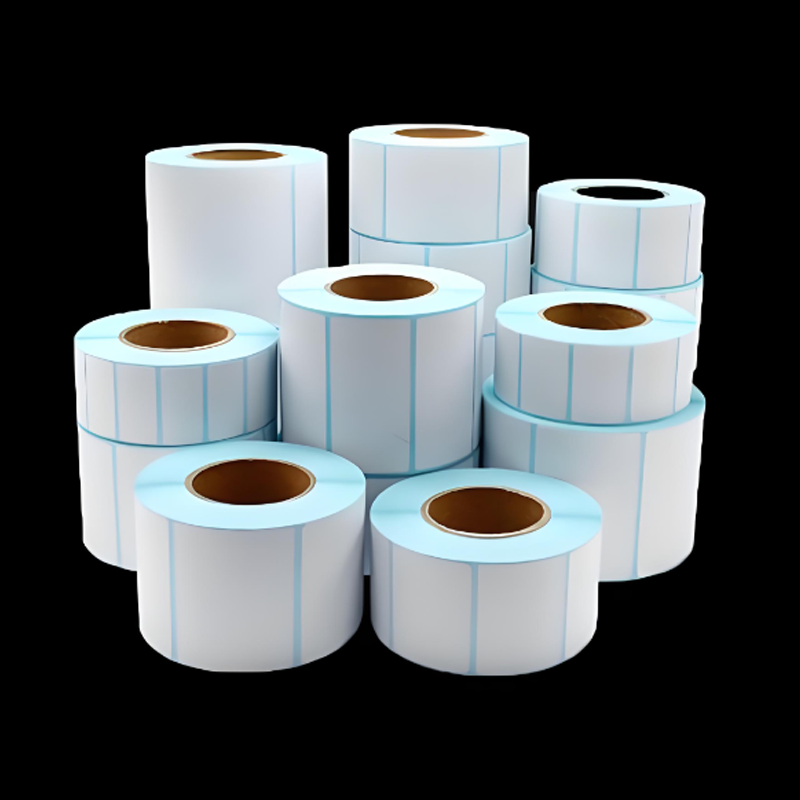
In commercial applications, label materials must perform reliably across large print runs while keeping per-unit cost manageable. Commercial label materials typically prioritize consistent printability, predictable adhesion across standard surfaces, and compatibility with high-speed labeling equipment.
The most common commercial label materials include:
For large commercial operations, material selection should also factor in liner type (silicone-coated paper vs. PET liner), release force, and compatibility with automatic applicators to minimize jams and downtime on the production line.
Roll label materials refer to label stock supplied on a continuous roll, pre-cut into individual labels and wound around a cardboard or plastic core. This format is the standard choice for any application requiring speed, consistency, and volume — from small businesses printing 500 labels a week to manufacturers running fully automated labeling systems at thousands of units per hour.
Unlike sheet labels, roll label materials feed continuously through thermal, inkjet, or laser label printers without manual reloading. This dramatically reduces labor costs in high-volume environments and ensures consistent label placement when used with automated applicators. The roll format also reduces storage footprint compared to sheet stock of equivalent label count.
Roll label materials are available across the full spectrum from economy paper to high-performance polyester film, making the roll format equally appropriate for a startup printing its first product batch and a pharmaceutical company labeling compliant medication packaging at scale.
With so many variables in play, a structured decision framework helps narrow the selection quickly. Ask these four questions before choosing a label material:
By working through these four questions systematically, most applications resolve to a clear material recommendation — reducing the trial-and-error that wastes both time and budget.
Beyond the material itself, the supplier relationship matters. A reliable label material supplier should offer consistent batch quality (so color, adhesion, and thickness do not vary between orders), a broad material portfolio covering both standard commercial label materials and specialized durable label materials, and technical support to help you select the right specification for your application. Roll label materials in particular demand tight manufacturing tolerances — inconsistencies in label gap, liner release force, or face stock thickness cause jams, misfeed errors, and costly production stoppages.
Requesting material samples before committing to a large order is always advisable, especially for new applications or when switching suppliers. Testing adhesion on the actual substrate, running a print test on your specific printer model, and evaluating durability under simulated use conditions takes only a few days but prevents far more expensive problems downstream.
Functional Composite Materials & Tapes Drive Innovation in Marine, Electronic, and Industrial Applications
Thermal Paper Rolls for Barcode Label Printing: What You Need to Know
Your email address will not be published. Required fields are marked *
 Self Adhesive Label Material Manufacturers