
 English
 русский
 Español
 عربى
عربى
Product Consultation
Your email address will not be published. Required fields are marked *

Coming From China, Marketing To The World.
Retail shelves restock faster. Warehouses ship more accurately. Hospitals track patients without manual errors. Behind each of these outcomes is a small, often overlooked material: the thermal paper roll used in barcode label printing. The global barcode and label printing thermal printer market was valued at USD 2.2 billion in 2025 and is projected to reach USD 3.5 billion by 2033 — a clear indicator that demand for reliable label printing substrates is anything but slowing down.
Content
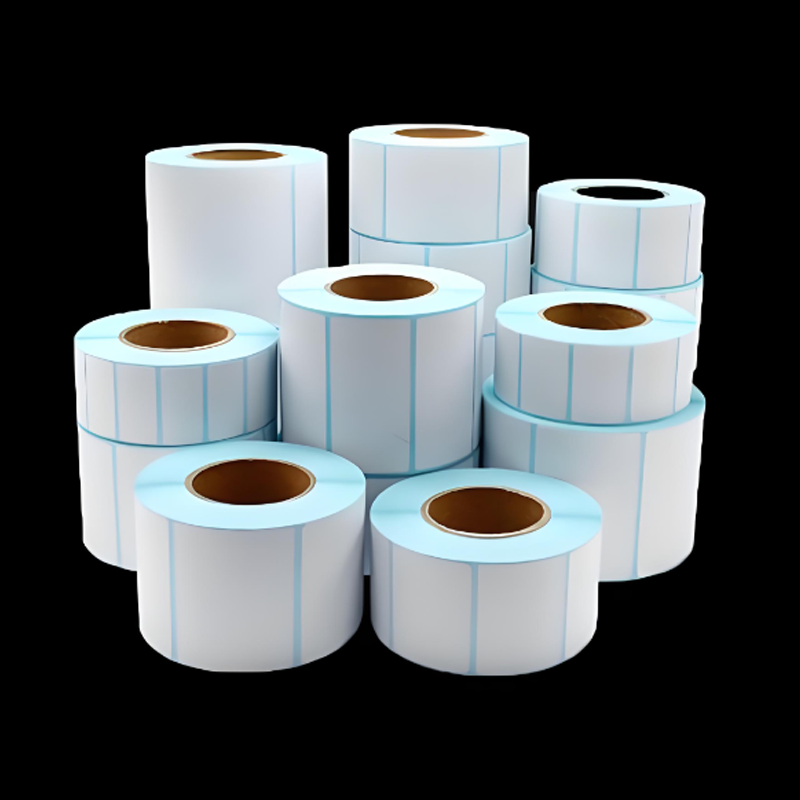
Thermal paper rolls work by responding to heat rather than ink. The surface is coated with a heat-sensitive chemical layer; when a thermal print head applies precise heat patterns, the coating reacts and produces crisp, high-contrast images — including the fine lines and spaces that make a barcode scannable.
There are two primary methods. Direct thermal printing applies heat directly to the coated paper surface, making it the go-to choice for short- to medium-term labels like shipping labels, POS receipts, and inventory tags. No ribbon is required, which reduces consumable costs and maintenance time. Thermal transfer printing, by contrast, uses a heated ribbon to transfer ink onto the label substrate, producing prints that withstand longer exposure to heat, UV light, and chemicals — preferred in pharmaceutical, automotive, and cold-chain logistics applications.
For barcode label printing specifically, print resolution matters enormously. A barcode with smudged or faded lines will fail to scan, causing downstream delays and operational disruptions. High-sensitivity thermal paper with a well-calibrated coating delivers the density and edge sharpness needed for consistent barcode readability across high-speed label printers.
Learn more about heat-sensitive label material for retail and logistics that supports both printing methods.
Retail is the largest end-user of thermal paper rolls. Every price tag, shelf label, and POS receipt printed in a supermarket or chain store depends on thermal technology. The 80mm roll remains the dominant format for standard checkout terminals, while 57mm rolls are gaining ground in mobile POS and compact handheld devices. Retailers demand rolls that print cleanly at speed — checkout lines stop for nothing.
Logistics and e-commerce represent the fastest-growing segment. Global parcel volumes are projected to exceed 200 billion per year, and every parcel needs a shipping label carrying a scannable barcode or QR code. Thermal labels suit this environment because they produce smudge-free, moisture-resistant prints without the handling delays of ink-based systems. Warehouses running dark-store fulfillment or last-mile delivery operations rely on thermal barcode labels for real-time tracking at every stage.
Healthcare applies thermal label printing to patient wristbands, medication packaging, and specimen tracking. In this setting, label legibility is safety-critical. A smeared barcode on a blood sample or medication pouch carries real risk. Thermal paper with reliable coating uniformity and temperature stability addresses this requirement directly.
Manufacturing uses thermal barcode labels for parts tracking, assembly line identification, and compliance labeling. Industrial environments introduce additional demands — exposure to oils, solvents, and wide temperature swings. This is where thermal paper's material properties, particularly oil resistance and chemical stability, determine whether a label survives the production floor.
Not all thermal paper rolls perform equally under real-world conditions. Several material properties determine whether a roll delivers consistent print quality across its full length and throughout its service life.
Coating sensitivity and uniformity determine how little heat energy is needed to produce a full-density image. Highly sensitive paper allows printers to run at lower temperatures, extending print head life and reducing energy use while maintaining barcode readability. Coating uniformity across the roll width prevents light or dark banding in printed barcodes — a common problem with lower-grade materials.
Water and oil resistance protect printed barcodes when labels are handled in wet or greasy environments — common in food retail, fresh produce logistics, and kitchen-side healthcare. A label that smears on contact with moisture will fail at the scan point, not at the printing stage, which makes the failure harder to catch.
Chemical resistance extends label life in industrial and laboratory settings where cleaning agents, solvents, or sterilization processes are routine. Labels that degrade on contact with common chemicals lose both readability and adhesion, compounding the problem.
Temperature and humidity stability govern how a roll performs over time and across environments. Thermal paper that darkens prematurely in storage, or fades when exposed to moderate heat, reduces usable shelf life and increases waste. Stable paper maintains consistent print density from the first label to the last, regardless of whether rolls are stored in a climate-controlled warehouse or a delivery vehicle cab.
Explore our full range of label materials to compare thermal paper with other substrates for specific application requirements.
Selecting a thermal paper roll starts with three practical questions: What size does your printer require? What environment will the label face after printing? And how long does the barcode need to remain legible?
On sizing, the most common widths for barcode label applications are 40mm, 50mm, 58mm, 76mm, and 80mm. Matching roll width and core diameter to printer specifications is non-negotiable — incorrect sizing leads to misfeeding, uneven printing, and damaged print heads. Roll length affects how often operators need to reload, which becomes a meaningful efficiency consideration in high-volume environments.
For labels that remain in controlled indoor environments and are scanned within days or weeks of printing, standard direct thermal paper is typically sufficient. For labels that face outdoor exposure, prolonged storage, or harsh physical conditions — logistics labels on international shipments, cold-chain tags, or long-term asset tracking labels — enhanced-durability thermal paper or thermal transfer substrates provide the additional resistance required.
Printer compatibility is equally important. Different thermal printer brands and models specify different paper sensitivities. Using paper that is too sensitive for a given printer produces overly dark prints that obscure fine barcode lines; paper that is insufficiently sensitive results in faded, unreadable output. Always verify the paper's sensitivity rating against the printer manufacturer's recommendation.
Finally, consider volume requirements. High-volume operations benefit from longer rolls or bulk purchasing to reduce changeover frequency and per-label cost, provided storage conditions prevent premature degradation of the thermal coating.
The thermal labels market, valued at approximately USD 1.03 billion in 2025, is projected to reach USD 1.61 billion by 2035 — a compound annual growth rate of 4.6%. Several converging trends explain this trajectory.
E-commerce growth continues to be the primary demand driver. Every online order generates at least one barcode label; high-volume fulfillment operations may generate dozens per order across pick, pack, and shipping stages. This creates sustained, predictable volume that rewards efficient, low-maintenance printing solutions.
Supply chain digitization is accelerating the transition from manual to barcode-based inventory management across industries that previously relied on paper-based systems. As more manufacturers, distributors, and healthcare providers implement real-time tracking, the installed base of barcode label printers expands — and with it, ongoing demand for compatible thermal paper rolls.
Sustainability is emerging as a purchasing criterion. BPA-free thermal paper formulations have become standard in many markets following regulatory pressure, and recyclable, linerless label formats are gaining traction as buyers seek to reduce material waste in high-volume labeling operations.
For the latest developments in thermal label materials and market applications, visit our industry news and application updates.
Durable & Commercial Label Materials Guide
PET Foam Cushioning: Properties, Applications, and Selection Guide
Your email address will not be published. Required fields are marked *
 Self Adhesive Label Material Manufacturers