
 English
 русский
 Español
 عربى
عربى
Product Consultation
Your email address will not be published. Required fields are marked *

Coming From China, Marketing To The World.
A laptop battery packer in Guangdong rejected three foam shipments in one quarter. The adhesive held on the PET carrier, but it crept at the die-cut edge after four hours at 60 °C inside the pack, and the residue fouled the placement nozzle. The cure was not a stronger adhesive. It was a 12 percent lower coat weight, a move from high-tack rubber to a crosslinked acrylic, and a tighter release profile on the liner.
Short answer first: a custom adhesive formulation earns its engineering time when one of three variables is under pressure, namely substrate surface energy, coat weight tolerance at your line speed, or the thermal and chemical load the bond meets in service. If none of the three is stressed, a catalogue grade with an established UL or VTM-0 record will normally be cheaper and faster to qualify.
Anhui Yanhe New Material Co., Ltd. has coated and laminated functional films on a 17-acre site in the Guangde Economic Development Zone since 2012, and most of its label materials, battery films and buffer products begin as a formulation question rather than a stock item. Its custom material development work starts with the customer's substrate, press and service conditions, then works back to a coating recipe.
Content
Five variables do most of the work. Changing any one of them moves peel, shear, tack and ageing at the same time, which is why a formulation is described as a window rather than a single number.
Natural rubber gives high initial tack on rough surfaces, acrylic emulsion resists UV and ageing, hot melt carries high coat weights without solvent, and silicone survives service above 200 °C. Raising crosslink density buys shear and heat resistance and costs you peel.
On a reverse-roll or slot-die head, plus or minus 5 percent coat weight control is realistic. Below roughly 12 gsm, pinholes and transfer gaps appear; above 60 gsm, you start fighting squeeze-out at the die.
PET sits near 42 dynes/cm and accepts most acrylics untreated. PP and PE sit at 30 to 31 dynes/cm and need corona treatment or a primer, and that treatment decays. Verify it within 24 hours of coating, not on a three-week-old roll.
Release force is specified in cN/cm. Too low and the label lifts on the liner during high-speed dispensing; too high and it tears at the matrix strip, wasting a full roll.
The adhesive must flow into the substrate texture during a nip dwell that can be 20 to 80 milliseconds. A formula that tests perfectly on a static press can still fail at 60 m/min.
Hot melt systems deserve a separate note, because they remove solvent from the equation entirely. A dual-silicone hot melt adhesive film such as YHTFTR-50 is coated as a 100 percent solids layer and activated by heat, so final bond strength is set by platen temperature, dwell and pressure rather than by a drying profile.
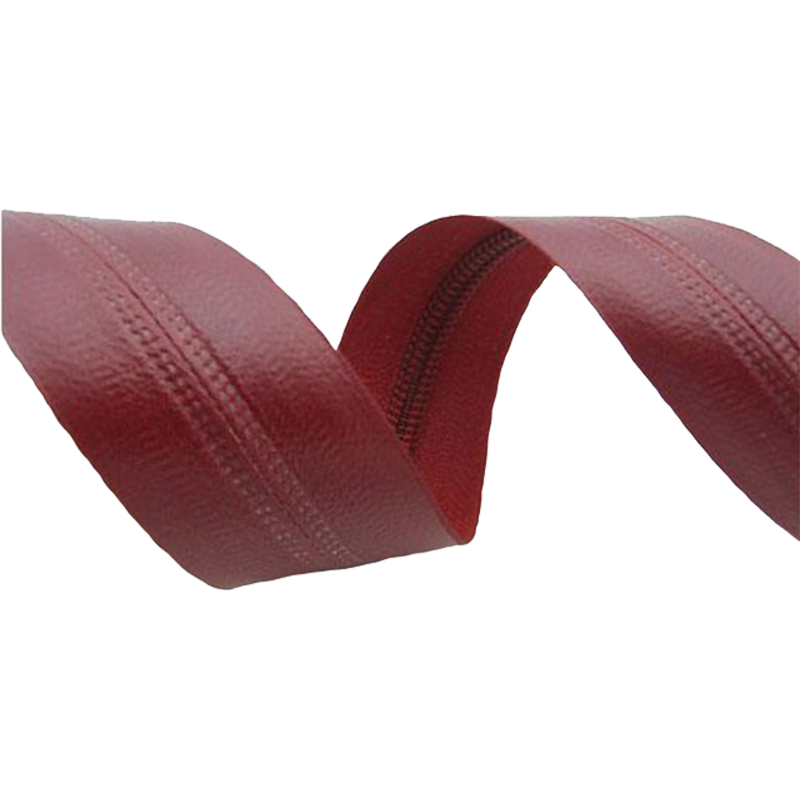 YH-TFTR 50# Dual-Silicone Hot Melt Adhesive FilmSubstrate: No substrate Glue thickness: customizableView Product →
A custom program is usually proposed too late, after a line has already lost output. These are the signals that make the case on data rather than opinion:
Battery and power electronics work is the clearest case. Inside a pack, a bond can see 60 °C in normal operation, 85 °C in abuse testing and a solvent-rich atmosphere during potting, while the module is still expected to pass a flame test. A film like the YHTFW-36-14-VTM0 white aerogel flame retardant packaging film is specified precisely because insulation and adhesion have to survive those loads together.
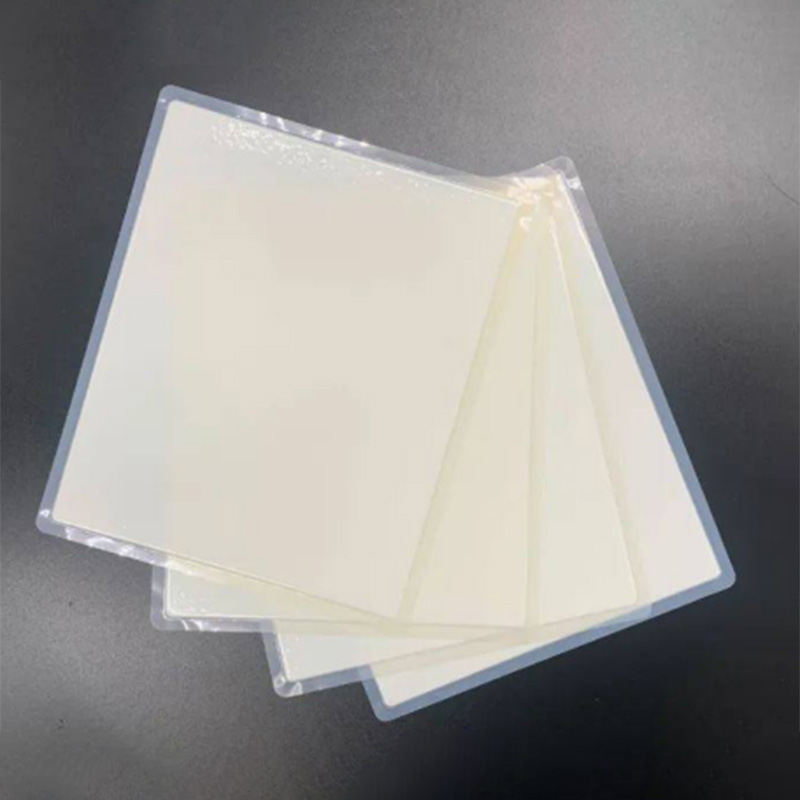 YH-TFW 36#+14 VTM-0 White Aerogel Flame Retardant Packaging FilmSubstrate: PET Glue thickness: customizable 180 ° steel plate peeling force: ≥ 10N/25mm T-type peel force: ≥ 12N/25mm Flame retardant grade: VTM-0View Product →
Coat weight tolerance is set by the coating method as much as by the adhesive, and the differences between reverse roll, gravure and slot die are set out in this guide to roll coating technologies. The table below compares what a converter typically gets in each case.
| Requirement | Catalogue grade | Custom formulation |
|---|---|---|
| Substrate match | Best fit from a fixed range, two or three grades usually tested | Built against the actual substrate and its surface treatment |
| Coat weight tolerance | Grade-specific, plus or minus 8 to 10 percent is common | Plus or minus 5 percent achievable with closed-loop control |
| Line speed fit | Customer adapts drying or dwell time around the grade | Rheology tuned to the existing dwell window |
| Time to first production run | Days, if the grade and width are in stock | Three to eight weeks including lab and line trials |
| Unit material cost | Baseline for comparison | Typically 5 to 20 percent above a stock grade |
| Qualification risk | Failures often surface late, during ramp-up | Failures surface in the lab or on a pilot run instead |
Material price is the number procurement sees, but it is rarely the largest line in the total cost of a bond that misbehaves. The breakdown below reflects typical converting projects where an adhesive mismatch reached production.
Downtime 34%
Scrap 24%
Adhesive 18%
Testing 14%
Claims 10%
Read the chart from left to right and the conclusion is uncomfortable. Downtime and scrap together account for roughly three times the adhesive price. A formulation that costs 12 percent more per square metre but removes one unplanned line stop per week pays for itself long before the next annual review.
Custom development is not evenly distributed across industries. Energy storage now drives the largest share of new requests, largely because pack designs change faster than material catalogues can respond.
Consumer electronics is the second engine, and it is a different problem. A laptop battery noise reduction label such as HTLB-25-B has to damp vibration, hold through thermal cycling and keep its flame retardant rating, all within a thickness measured in tens of microns.
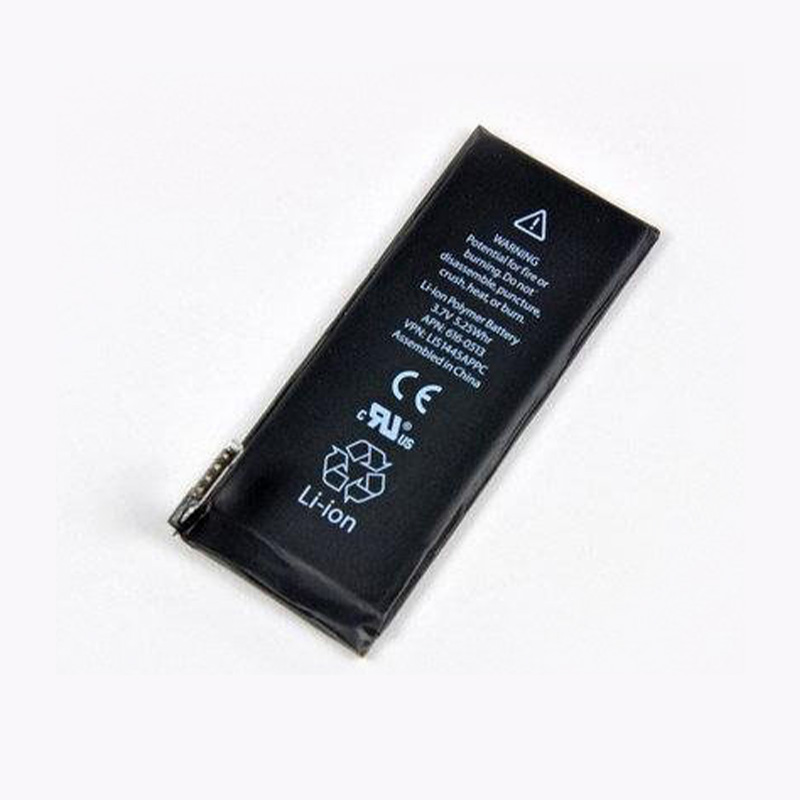 HTLB 25#(B) Flame Retardant Laptop Battery Noise Reduction Label StickersSubstrate: PET Glue thickness: customizable 180 ° steel plate peeling force: customizable Flame retardant grade: VTM-0View Product →
Most projects follow the same six stages. The estimates below assume a two-layer film with one functional coating, run on existing equipment.
Step 1, scoping, week 1. Substrates, line speed, dwell time, service temperature and regulatory limits are written down as numbers.
Step 2, failure analysis, week 1. The failed sample is tested rather than described, so peel, shear and release values are known before blending starts.
Step 3, lab prototyping, weeks 2 to 3. Three to five candidates are coated on a bench unit and screened at 65 °C and 85 percent humidity.
Step 4, pilot coating, week 4. The lead candidate runs on production equipment to check coat weight control and web handling.
Step 5, line trial, weeks 5 to 6. Material is run on the customer's press at full speed, including die-cutting and dispensing.
Step 6, validation and scale-up, weeks 6 to 8. Specifications, control limits and batch records are frozen before the first commercial order.
A formulation is only as good as the batch records behind it. Four controls keep a custom product stable over years of supply.
Written into a quality agreement before the first production order, these items cost very little. Negotiated afterwards, they cost a full requalification cycle and, in battery supply chains, a customer audit that could have been avoided.
Your email address will not be published. Required fields are marked *
 Self Adhesive Label Material Manufacturers