
 English
 русский
 Español
 عربى

Product Consultation
Your email address will not be published. Required fields are marked *

Coming From China, Marketing To The World.
A carton-sealing line runs well for three weeks, then fails on a Friday afternoon: flaps lift at the end of the conveyor, glue strings form on the nozzle, and the maintenance team asks for the “melting point” of the hot melt glue. That single number rarely solves the problem. The adhesive may have melted correctly and still failed because the service temperature, open time, substrate, or nozzle calibration was wrong.
Start with the service limit, not the melting point. For common EVA hot melts, the reported melting point is often around 130°C (266°F), while the practical service temperature may be only -30°C to 80°C (-22°F to 176°F), with some high-heat grades reaching about 110°C (230°F). Application temperatures are usually higher than both: 120–130°C for low-temperature systems and roughly 175–205°C for many standard packaging grades.
The useful question is not “What is the melting point?” but “What temperature must the bond survive in service, and what temperature must the glue reach to wet the substrate at line speed?” Those are different measurements, taken for different reasons, and confusing them is a common procurement and process risk.
Content
Hot melt adhesives are thermoplastics. They soften when heated, flow under pressure, and bond as they cool. Suppliers may report a ring-and-ball softening point, a melt or flow point, a recommended application window, and a service temperature range. These values move together, but they do not replace one another. A glue with a 130°C melt point may still need a 180°C tank and hose to flow fast enough for a high-speed packaging line.
A common lab index, often reported by ASTM E28 or ISO 4625. It indicates when the material softens under a defined test, not when your production line should run.
The approximate temperature at which the adhesive becomes a flowing liquid. For many EVA grades this is near 130°C, but formulation and filler content shift the value.
The tank, hose, and nozzle range needed for wetting, open time, and line speed. Low-temperature systems may run at 120–130°C; standard grades often run much hotter.
The continuous exposure limit after the bond is made. This is the number that matters for a pallet in a hot warehouse, a battery pack, or a pipe near radiant heat.
For film-format adhesives, the same logic applies, but heat is transferred through a carrier rather than a bulk tank. A hot melt adhesive film guide is useful when comparing activation temperature with bond-line thickness and press time.
 YH-TFTR 50# Dual-Silicone Hot Melt Adhesive FilmA substrate-free hot melt adhesive film with customizable glue thickness, worth comparing when reviewing film activation and bond-line requirements.View Product →
EVA-based hot melts are common in packaging and labelling, and their typical melting point is about 130°C. Polyolefin and higher-performance formulations can be engineered for higher heat resistance, lower application temperature, or better adhesion to low-surface-energy plastics. A low-temperature glue stick may liquefy near 121°C, while a standard industrial grade may be dispensed at 177–205°C. The difference is not marketing language; it changes tank settings, energy use, char risk, and operator safety.
Humidity also matters. Moisture in the air or on the substrate can cool the adhesive surface before it wets out, especially on fast lines or in chilled rooms. Overheating is equally damaging: it can oxidize the polymer, create char and nozzle build-up, reduce viscosity, and produce a bond that looks acceptable at first but fails under peel or shear load.
For label converters using hot-glue thermal paper, the adhesive rheology must match the printer and applicator, not just the paper face. A product such as a three-proof hot-glue thermal paper is selected for both print durability and the adhesive’s dispensing window.
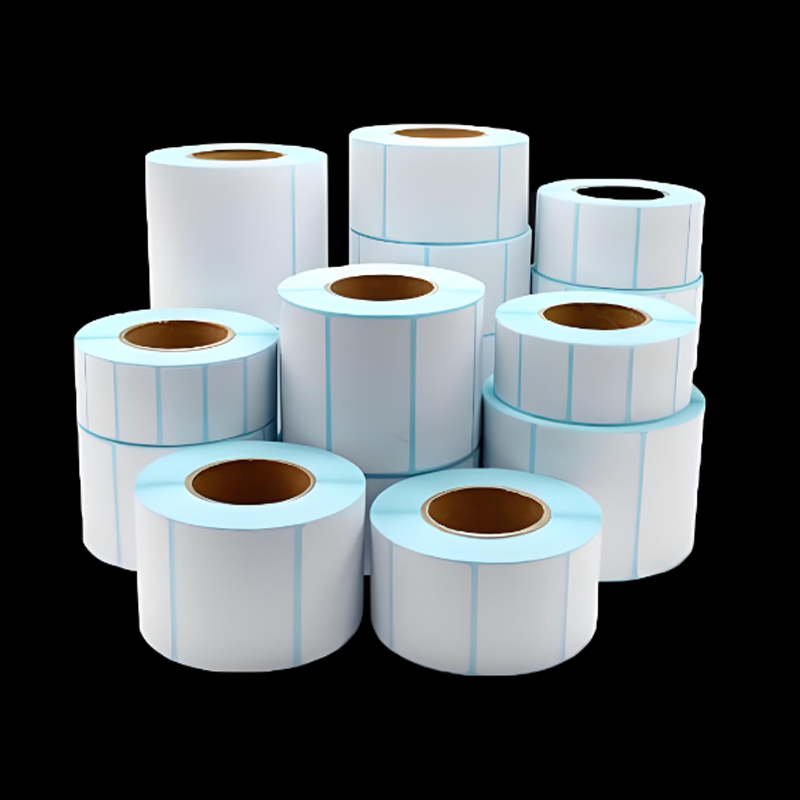 R-HRM-3F 3-Proof Hot Glue Grid Base Thermal PaperA thermal paper label material with hot-glue grid base, customizable glue thickness and 180° steel plate peeling force for specification review.View Product →
Table note: values are typical ranges for specification discussion, not a substitute for a supplier data sheet or line trial.
The chart below shows why “melting point” is a poor proxy for heat resistance. Bar length is scaled to 200°C.
A bond made at 175°C is not a bond rated for 175°C. The polymer must still resist creep at the actual service temperature.
Use this as an illustrative planning mix for a converting plant, not as a published global market share. Packaging and labelling dominate volume, but electronics and battery components often carry the strictest heat and traceability requirements.
Set the maximum continuous surface temperature plus a safety margin. Include warehouse, transport, and end-use excursions.
Low-surface-energy plastics, oily metal, and coated paper behave differently. Adhesion failure is often mistaken for heat failure.
Check tank, hose, nozzle, and open time against line speed. A “correct” melt point can still cause stringing or cold bonds.
Test peel, shear, and creep after heat aging, humidity aging, and cold exposure. Record the failure mode, not just pass or fail.
Use the certificate of analysis and a routine softening-point check to catch batch drift before it reaches the line.
A practical quality plan uses a testing laboratory for more than a single melt-point reading. Viscosity, color, adhesion, and heat aging together show whether a batch is likely to perform like the approved sample.
The next time a hot melt bond fails, ask three questions in order: What continuous temperature must the joint survive? What application window does the substrate and line speed require? What softening point and batch history does the supplier certify? The melting point is a useful starting fact, but the service limit and process window decide whether the bond holds.
Your email address will not be published. Required fields are marked *
 Self Adhesive Label Material Manufacturers